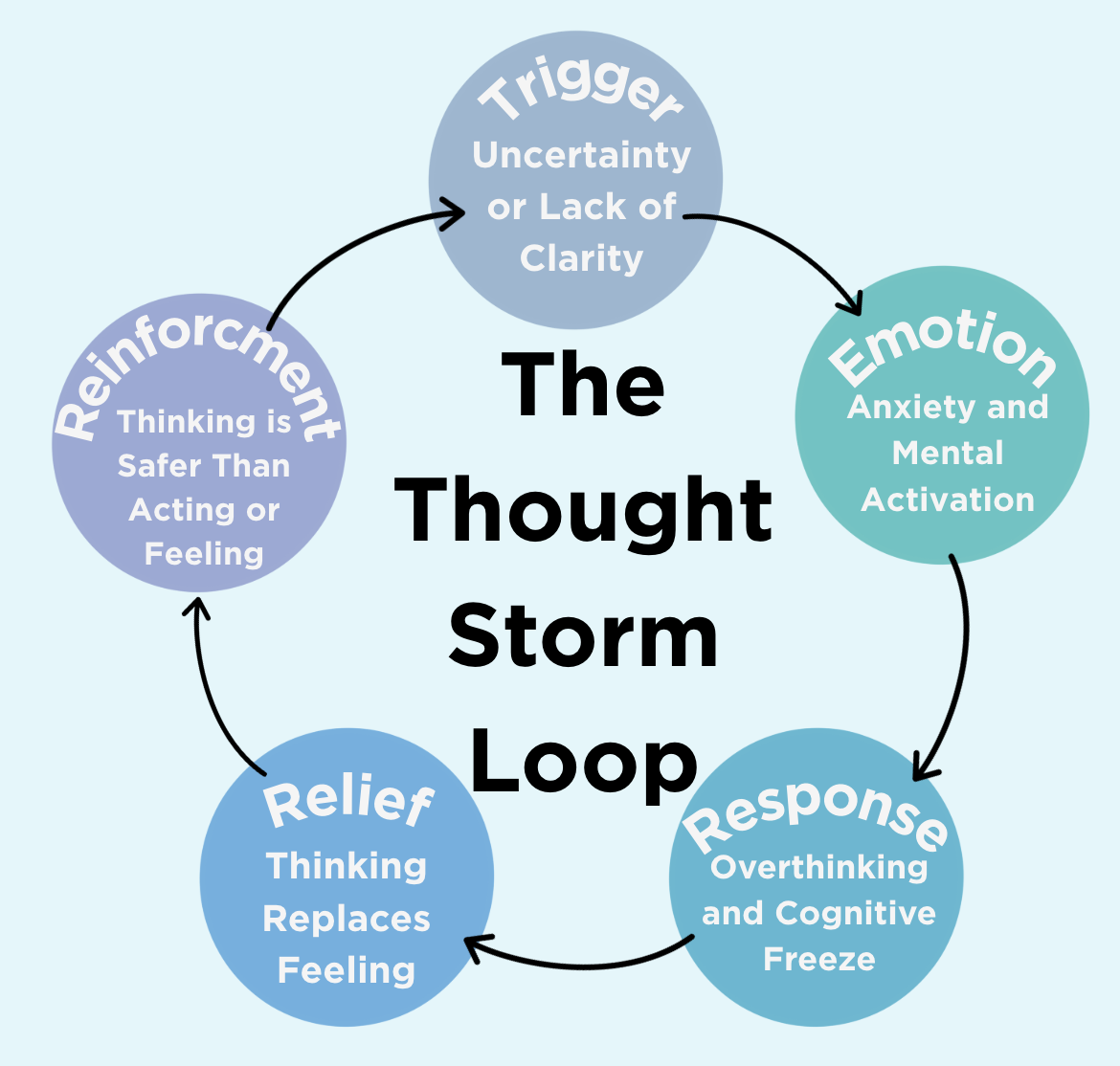
How The Thought Storm Can Trigger the Urgency Loop
When thinking can’t tolerate uncertainty anymore
When the Thought Storm loop keeps running without resolution, uncertainty starts to feel unbearable. The longer you stay in your head, the more pressure builds in your body. Eventually, thinking gives way to action — activating the Urgency Loop.
What happens:
- You reach a breaking point where you feel like something has to happen now to stop the mental noise.
- You suddenly feel compelled to address the issue immediately — sending the text, starting the conversation, or pushing for an answer.
- You move from careful analysis to quick action, even if you’re not fully ready, just to relieve the internal pressure.
- The moment there is movement or response, the mental looping eases, even if the situation itself isn’t fully resolved.
How Thought Storm Can Trigger the Peace Keeper Loop
When the Thought Storm loop centers on how someone else might feel, react, or interpret your words, fear of disruption starts to rise. Instead of staying in analysis, your system shifts toward protecting connection — activating the Peacekeeper loop.
What happens:
- You replay the interaction while focusing on how the other person may have felt, reacted, or misunderstood you.
- You analyze whether your words came across too strong, too blunt, or potentially hurtful.
- You start rewriting what you said in your head, softening language and imagining ways to smooth things over.
- Instead of expressing what you actually feel, you move toward minimizing, apologizing, or accommodating to prevent conflict or disconnection.
How Thought Storm Can Trigger the Worth Proving Loop
When the Thought Storm loop doesn’t lead to clarity, the mind can begin interpreting uncertainty as a personal shortcoming. Instead of just trying to understand, your system shifts toward doing — activating the Worth-Proving loop.
What happens:
- Your thoughts turn critical, questioning whether you’ve done enough or handled things well enough.
- You start looking for something productive to focus on — a task, goal, or responsibility — to regain a sense of control.
- You push yourself to work harder, fix more, or achieve something tangible to quiet the mental noise.
- Relief comes not from understanding the situation, but from staying busy or productive enough to stop thinking about it.
How Thought storm Can Trigger the Hide and Hope Loop
When thinking becomes too overwhelming
When the Thought Storm loop doesn’t bring clarity or relief, mental pressure keeps building. Your mind stays busy, but nothing feels resolved. Instead of continuing to think, your system shifts toward pulling away — activating the Hide & Hope loop.
What happens:
- You feel mentally exhausted from replaying the same thoughts without reaching a clear answer.
- You begin avoiding the situation altogether — delaying responses, putting off decisions, or disengaging from conversations.
- Your energy drops, and you may feel foggy, numb, or disconnected from what you were thinking about.
- Instead of staying in analysis, you freeze or withdraw, hoping the situation will resolve without you having to engage further.
How Thought Storm Can Trigger the Trauma Magnet Loop
When thinking activates attachment and longing
When the Thought Storm loop fixates on a specific relationship, person, or emotional bond, unresolved attachment pain can surface. Thinking keeps returning to the connection — activating the Trauma Magnet Loop.
What happens:
- You replay past interactions with the person, focusing on moments of closeness, loss, or inconsistency.
- You analyze what the relationship means, what went wrong, or what you could do differently to restore connection.
- You feel pulled to reach out, re-engage, or reopen the dynamic — even if it’s painful or familiar.
- Instead of gaining clarity, the thinking intensifies emotional attachment, drawing you back toward a relationship that activates old wounds.