Why the Behavior Keeps Coming Back (Even When You Try to Change It)
Have you ever tried to change a behavior— like overeating at night— only to realize the pattern keeps coming back anyway?
You promise yourself you’ll have more self-control tomorrow.
You plan better meals.
You tell yourself, This time I’ll stop.
And for a while… it works.
You eat “clean.”
You feel proud.
You think, Maybe I finally figured it out.
Until one stressful day hits.
Or you feel overwhelmed.
Or exhausted.
Or emotionally full in a way you can’t name.
And suddenly, you’re right back in the kitchen— wondering why nothing ever really sticks.
Here’s what’s actually happening.
It’s not about willpower—it’s about your nervous system.
The Cycle You Were Never Taught to Stop
Picture yourself on a treadmill.
At first, everything feels manageable.
You’re walking. Maybe even jogging.
You think, I’ve got this.
Then—without warning—the speed increases.
You look for the controls.
There’s no key.
No instructions.
No one ever showed you how to slow it down safely.
Your body reacts before your mind can catch up.
Your heart starts racing.
Your breathing shortens.
Your nervous system flips into survival mode.
This is the moment loops are born.
The First Strategy That Brings Relief
So you do the first thing that brings relief.
You step onto the sides of the treadmill.
You’re still technically on it—but you’re no longer running.
Your heart rate drops.
You can breathe again.
Your system registers: This works.
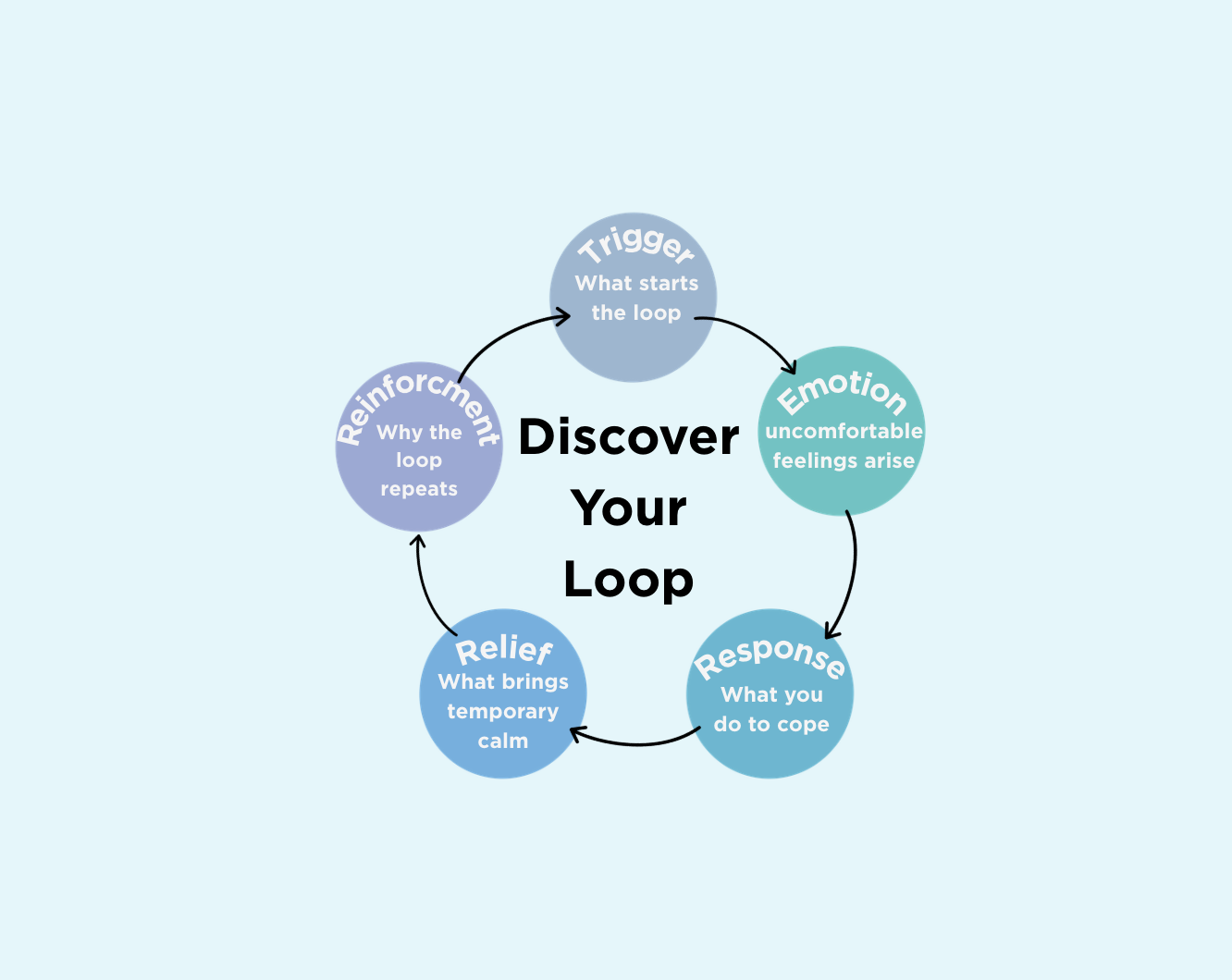
That’s exactly how the emotional loop works.
When pressure builds and your internal “speed” increases, your nervous system looks for the fastest way to feel relief. The behavior you reach for—the one that helps you breathe again—becomes your go-to strategy.
That response becomes your primary loop—the strategy your nervous system learned to get back to safety.
That response becomes your primary loop—the strategy your nervous system learned to get back to safety.
Not because you’re weak.
Not because you’re avoiding something.
Not because you lack discipline.
But because, in that moment, it worked.
Why Loops Form in the First Place
This part matters.
Subconscious loops didn't form because something was wrong with you.
They formed because something essential was missing.
You needed:
- The key
- Instructions
- Someone to show you how to slow the machine down without getting hurt
Without those, your nervous system did the most intelligent thing it could with the information it had.
It found relief.
And once relief is found, the body remembers.
When the First Strategy Stops Working
But then—something changes.
The treadmill speeds up even more.
Stepping onto the sides doesn’t feel stable anymore.
The relief doesn’t come.
So your nervous system adapts again.
This time, you jump.
You scrape your knees.
You get hurt.
But at least—you’re off the treadmill.
That becomes your secondary loop.
Often more extreme.
Often more costly.
But driven by the exact same unmet need.
“I don’t know how to stop this safely.”
What Healing Is Not
This is where most approaches miss the mark.
Healing is not about learning how to jump without getting hurt.
And it was never about trying harder to stay on the treadmill.
The behavior was never the problem.
The unmet need was:
“I don’t know how to stop the treadmill.”
Why We Ask Different Questions
This is why, at behavior & emotion, we don’t start by asking:
“Why do you keep doing that?”
That question assumes choice without context.
Instead, we ask:
“What did this subconcious loop protect you from—when you didn’t have another option?”
Because loops don’t tell us what’s wrong with you.
They tell us what was missing.
Finding the Key
When you understand your loop, you can trace it back to the original unmet need.
Not with judgment.
Not with shame.
But with clarity and compassion.
And when that need finally gets met—when your nervous system learns how to slow the machine down safely.....
The treadmill doesn’t have to keep running.
You don’t need better behavior.
You need the key.
Discover what your loop has been trying to protect—and what it’s been asking for all along.